BusiVine: From Legacy to Launch
How we're transforming a 15-year-old farm management system into a global AI-first SaaS platform.
The Starting Point
15 Years of Agricultural Intelligence — Trapped in Access

BusiVine is a mature viticulture management system with over 15 years of production use. It contains:
- 494 database tables (212 backend, 282 frontend/UI)
- 1,030 forms (836 data entry, 194 dialogs)
- 647 reports across financial, operational, harvest, compliance, and analytics
- ~1.2 million transactional records
- Operational domains spanning vineyard management, chemical compliance, harvest operations, labour, financial management, and safety
That's not a throwaway system. That's decades of hard-won agricultural knowledge encoded in software. The job isn't to replace it — it's to liberate it.
The Demo Stack
Built in One day. By One Engineer.
The BusiVine prototype is live at busivine.com — a working cross-platform system with a web dashboard, a mobile field app (built in Flutter in ~2 hours), shared authentication, real-time data, Google Maps integration, and PDF report generation.
| Layer | What's Running |
|---|---|
| Web App | Nuxt v4 (Vue 3 / SSR) |
| Mobile | Flutter (Android, iOS) |
| Database | Supabase (Postgres + Realtime) |
| Auth | Custom-built (using AES-256-GCM) |
| Hosting | Netlify |
| Maps | Google Maps Platform |
This stack was chosen for speed to proof-of-concept. It demonstrates the architecture, the data flow, and the velocity of AI-augmented engineering.
The Enterprise Target Stack
Pragmatic Now. Clear path to Enterprise-Grade.
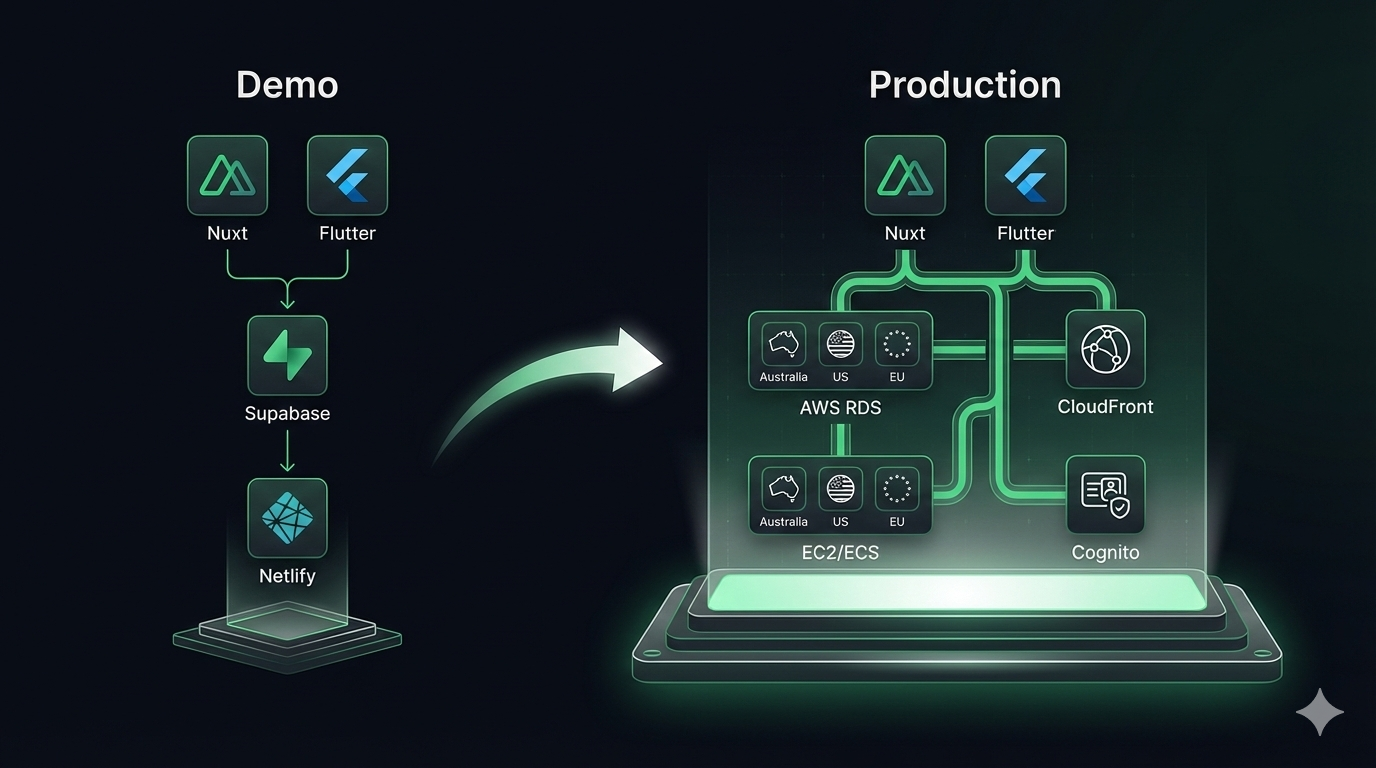
For a commercial SaaS platform selling into global enterprise agriculture, the production stack moves to AWS — portable, secure, auditable, and free from vendor lock-in.
| Layer | Demo (Now) | Production (Indicative Target) |
|---|---|---|
| Frontend | Nuxt v4 | Nuxt v4 |
| Mobile | Flutter (iOS + Android) | Flutter (iOS + Android) |
| Backend | Supabase | AWS RDS (PostgreSQL) + custom API |
| Auth | Custom-built | AWS Cognito or purpose-built |
| Hosting | Netlify | AWS EC2 / ECS + IaC |
| Database | Supabase Postgres | AWS RDS PostgreSQL — multi-region |
| CDN | Netlify Edge | AWS CloudFront (or CloudFlare at scale) |
| Maps | Google Maps | Google Maps (or Mapbox at scale) |
No hyperscaler lock-in. No bespoke cloud services. Standard PostgreSQL, standard compute, infrastructure-as-code throughout. Avoid serverless complexity and bill shock.
The Migration Strategy
Strangle, Don't Rebuild
The most common way to fail a legacy modernisation is the "big bang rewrite" — disappear for 18 months, lose institutional knowledge, deliver something that doesn't match what the business needed. We won't do that.
Step 1: Get the Data Out
Pull all 494 Access tables into PostgreSQL. Establish continuous replication from the live system. The modern platform has access to real, current data from day one.
Step 2: Strangle Function by Function
Migrate capability by capability — screens, business logic, reports, integrations — while Access keeps running. Users transition gradually. No "migration day" cliff edge.
Step 3: Sequence by Strategy
The order of migration is a business decision: which functions do enterprise customers need first? Where's the highest compliance risk? What can be onboarded with zero-touch? Chemical compliance and spray operations are a potential natural beachhead.
Data Migration — LLMs Change Everything
LLM-powered agents allow us to control migration out of Access using English.
Migrating from Access to PostgreSQL used to mean weeks of specialist work handling OLE objects, attachment fields, loose relationships, and implicit typing.
In 2026, LLMs parse schema definitions, identify data quality issues, generate migration scripts, and handle edge cases that would have consumed weeks of a developer's time.
Approach: Replicate the schema as-is first — get the data operational and continuously integrated. Normalise and redesign progressively as each domain migrates to the new stack. Allow each functional migration to be executed as a "two-way door": incremental and easily reversible.
This is AI-augmented engineering at its most practical: not the glamorous AI-first product story, but the essential, unglamorous work of getting data from A to B correctly, faster and cheaper than was possible three years ago.
Going Global
Multi-Region from Day One
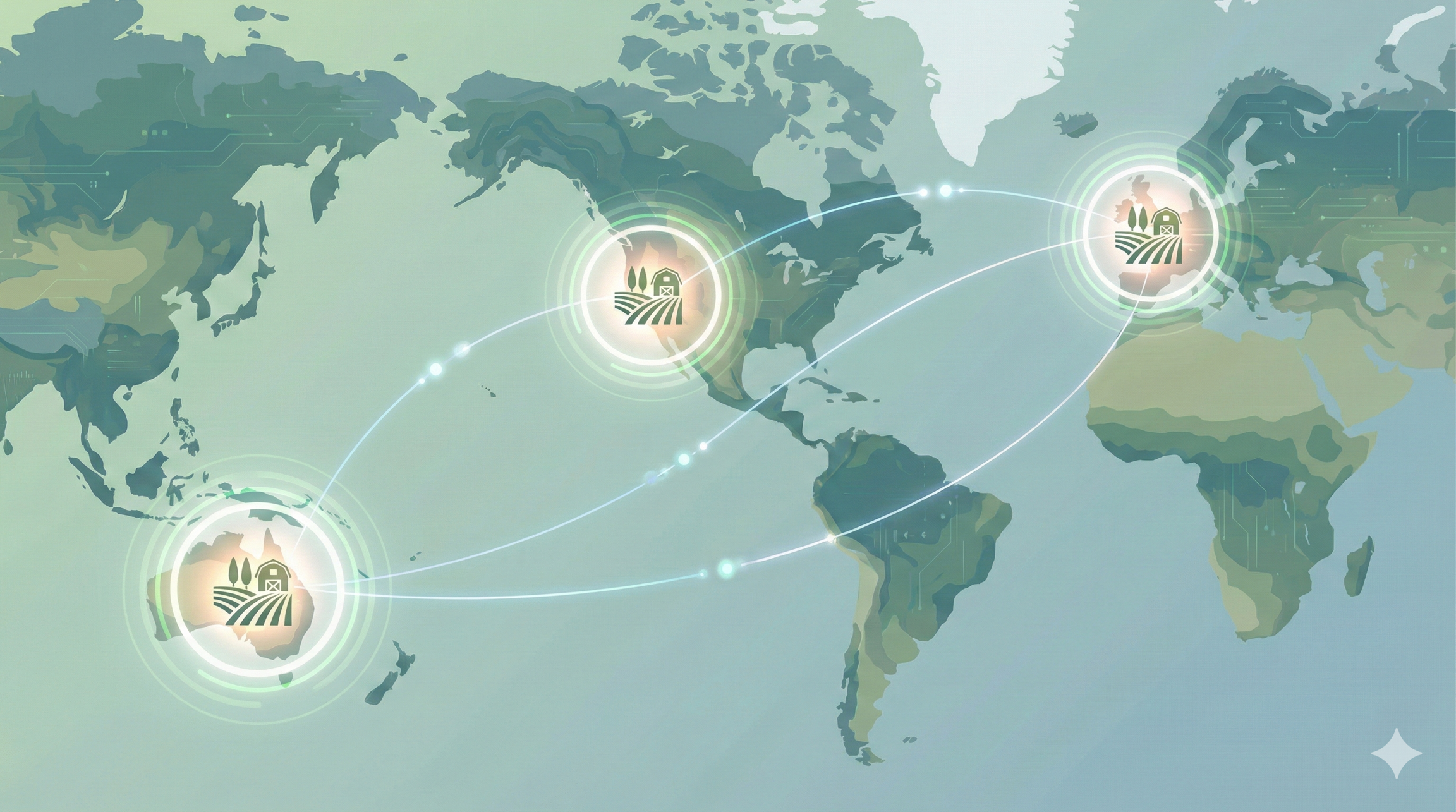
If BusiVine is going international, that's an architectural decision made at the start, along with banking in multi-tenancy at the core of the platform data and operating model.
- Deploy into multiple AWS regions from launch (suggest Australia + US/EU).
- Establish a virtual tenant in each region — a synthetic farm generating realistic transactions continuously.
- Exercise the full stack under real conditions: replication, auth, latency, compliance boundaries, audit and disaster recovery.
- When the first international customer signs up, the platform is already proven in their region.
Cost at small scale: a few hundred dollars a month. Confidence and credibility when selling into enterprise agriculture: priceless.
Platform Strategy
Own the Domain. Connect to Everything Else.
The legacy system has 647 reports and a built-in payroll module. The instinct is to rebuild them all. This needs a full evaluation, business plan fit-check and pressure test against BusiVine's distribution (Go-To-Market) strategy.
Reporting is commodity.
Any SaaS can generate a PDF. BusiVine's advantage should be real-time APIs, agricultural industry network integration, supply chain traceability, and digital compliance — not static documents.
Payroll is a solved problem.
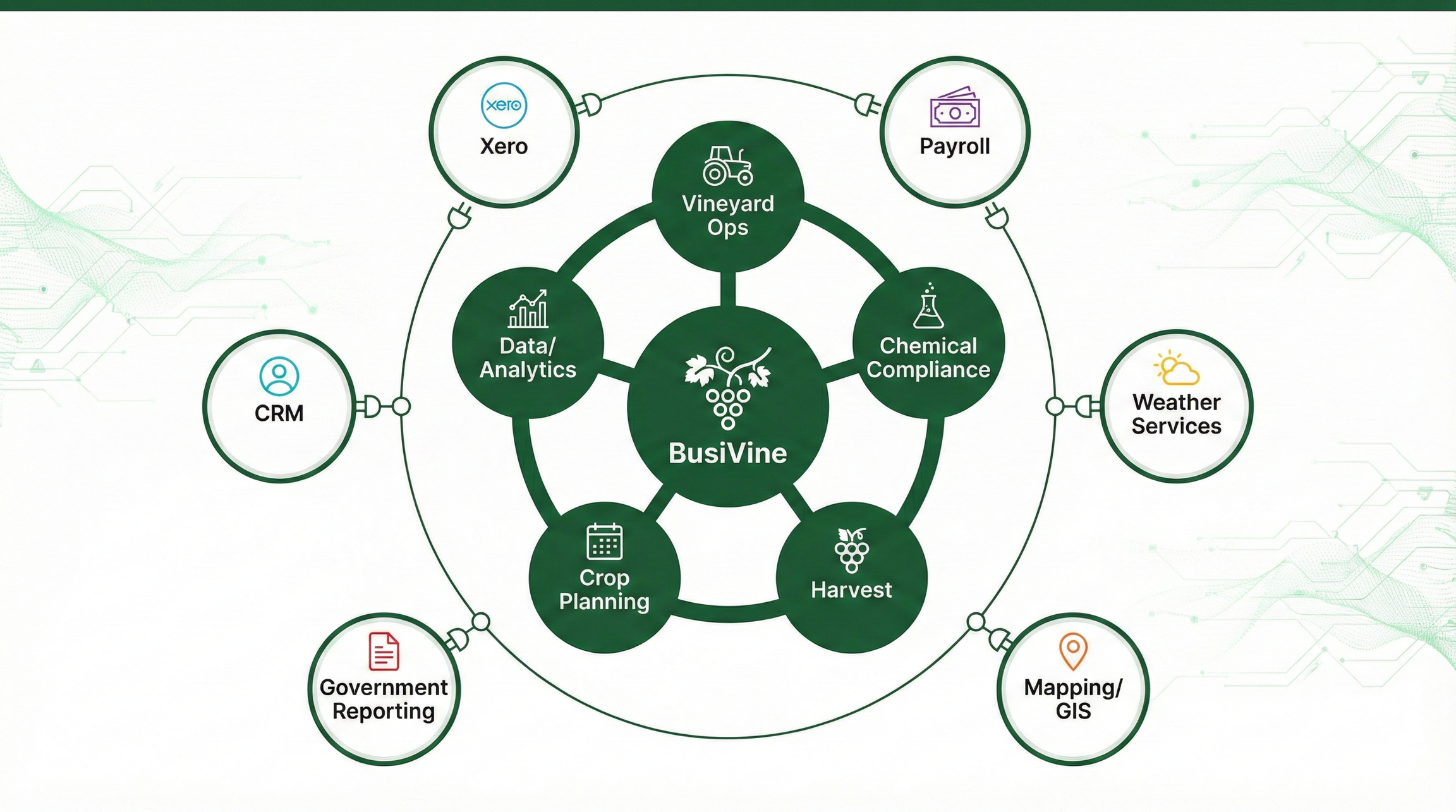
Xero, MYOB, KeyPay, Employment Hero. Every farm already runs one. Build connectors, not a clone. Labour and Ag-specific productivity tracking is BusiVine's domain; pushing that data into existing payroll systems is a sales enabler.
The principle:
Own the domain-specific value — vineyard ops, chemical compliance, harvest management, crop planning, data analytics. Connect to everything else — payroll, accounting, weather, mapping, government reporting, CRM.
This keeps the team lean, the product focused, and the sales pitch pure and simple.
AI — Where It's Real
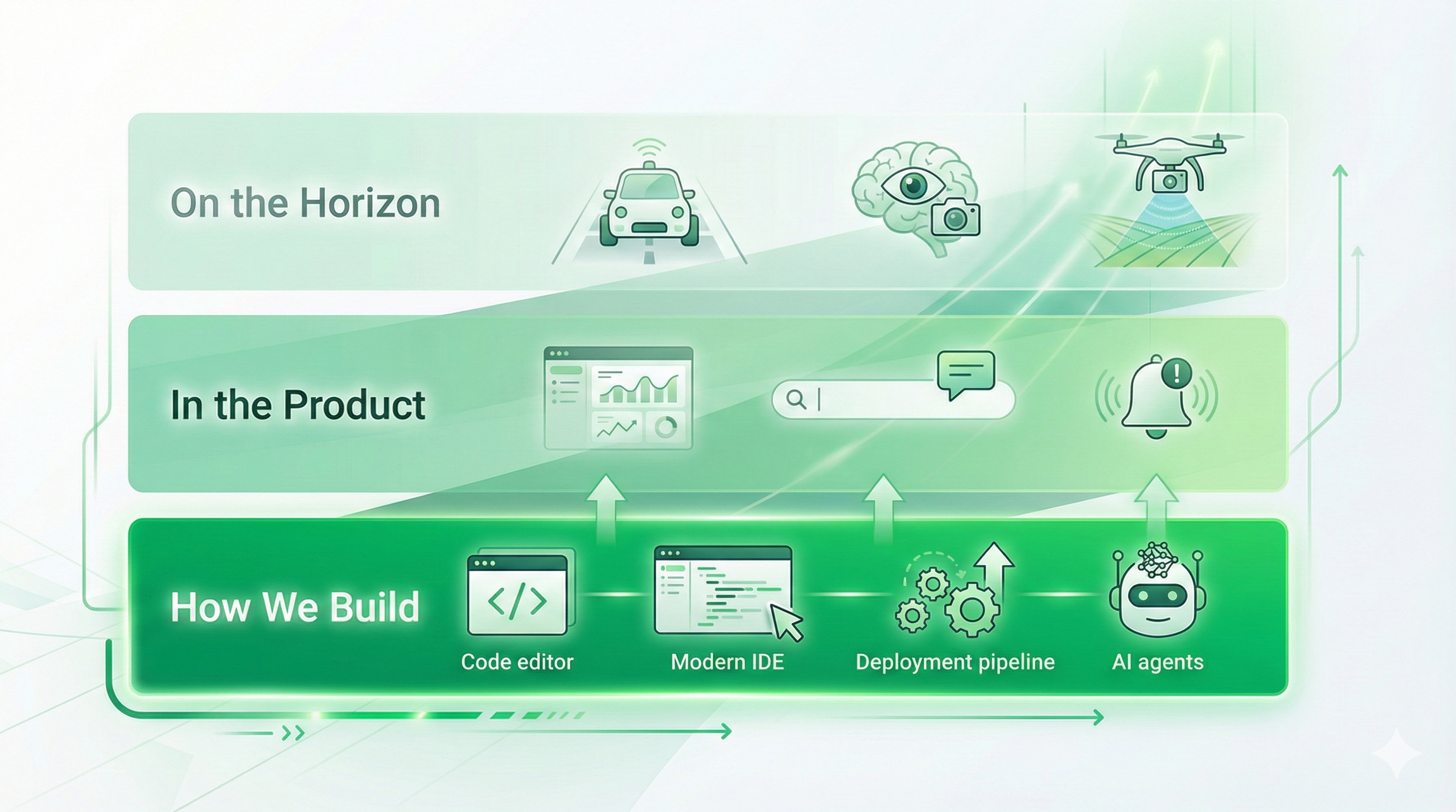
AI in How We Build
- Claude Code for agentic engineering — disciplined, controlled, architecture-driven AI collaboration across every phase of the SDLC.
- Replicate.com for AI model deployment — practical, low-cost access to frontier AI capabilities without building ML infrastructure.
- AI agents in operations — semi-autonomous marketing, customer service, and onboarding, proven in production at a growing list of the world's leading businesses.
AI in the Product
With agentic-engineering, we can now quickly deploy machine-learning capabilities that used to require in-house PhDs and months of complex work.
Near-term: Anomaly detection on chemical compliance. Predictive scheduling for spray timing, labour, and harvest. Natural language querying — ask your data questions in plain English.
Medium-term: Cross-farm benchmarking across tenants. Yield forecasting at scale. Computer vision for crop health (drone/satellite imagery).
On the horizon: Autonomous decision support for chemical application — building toward it responsibly, without over-promising.
Team Model
Small Teams. Massive Output.
The era of 8-person squads is over. AI has fundamentally changed the economics of software delivery.
Maximum team size on BusiVine: 2 humans per domain. One technical, one product. Each pair ships end-to-end, amplified by AI tooling. Example product team - BusiVine at scale:
| Role | Count |
|---|---|
| CTO / Product Architect | 0.5-1 |
| Full-stack Engineers | 1-2 |
| Product / Domain Lead | 1-2 |
| Design | Fractional / Freelance |
4–5 people delivering what 15–20 would have three years ago.
- Ways of working are changing every few months.
- Small teams are much better than large ones.
- Influenced by 37signals (DHH & Jason Fried): Pair a technology expert with a product expert. Both must have good taste.
- In the 2026+ world, each team member will likely need a token budget that is a significant (i.e. 5-10%) of their base salary.
The 90-Day Plan
Phase 1 — Discovery & Assessment (Weeks 1–4)
- Deep-dive audit of the existing system: codebase, database schema and data assets, infrastructure, integrations, and deployment model.
- Map all business processes and domain logic embedded in the system — crop/vineyard management, soil and climate data, planting and harvest cycles, input tracking, compliance and reporting, inventory, sales and distribution, and any other operational workflows.
- Interview key stakeholders: founders, agronomists/farm managers, operational staff, original author of the system and existing technical staff.
- Identify pain points, manual workarounds, unmet needs, and the highest-value opportunities for modernisation.
- Assess technical debt, security posture, data quality, and regulatory/compliance requirements relevant to agricultural SaaS.
- Evaluate the current data estate — what's there, how it's structured, and what's valuable as training data for AI/ML capabilities.
- Document current-state architecture, data flows, and integration points.
- Review and refine the BusiVine business plan.
Deliverable: Current State Assessment Report.
Phase 2 — Platform and Product Strategy (Weeks 5–9)
- Confirm target-state architecture and modernisation roadmap.
- Develop product architecture comprising functional decomposition, data model and entity definitions, proposed service catalogue and CX flows (user journeys).
- Decide build vs. buy for each functional domain — where Karrawatta's proprietary logic and data are a genuine competitive advantage vs. where commodity platforms would be more pragmatic.
- Define data migration strategy, risks, and sequencing. Migration pilot to prove the continuous integration model.
- Institute agentic engineering to build out an E2E "steel thread" of a candidate function fully migrated to platform.
- Develop the distribution approach: Assess the SaaS commercialisation opportunity. What does the platform need to look like to serve multiple agricultural customers, and what's the minimum viable product for market entry?
Deliverables:
- Integrated reference implementation
- Migration operations pilot complete
- Architecture knowledge base established and integrated
- Architecture Decision Registry populated
- Modernisation operating plan drafted
- Distribution strategy drafted
Phase 3 — Roadmap & Plan (Weeks 10–12)
- Develop a phased modernisation roadmap with clear milestones, decision gates, and dependencies. Phases are defined by platform target maturity (MVP, MLP, Scaled operations) across functional domains.
- Platform operating plan covering project, resource, financial, implementation, vendor, launch and distribution plan.
- Recommend team structure and sourcing model.
- Identify quick wins — things that can be delivered in the near term to build momentum, prove the approach, and demonstrate value to stakeholders.
- Present findings and recommendations to founders and key stakeholders.
- Clickable prototype covering MVP feature set.
Competitive Position
Why "Still on Access" can be an Advantage
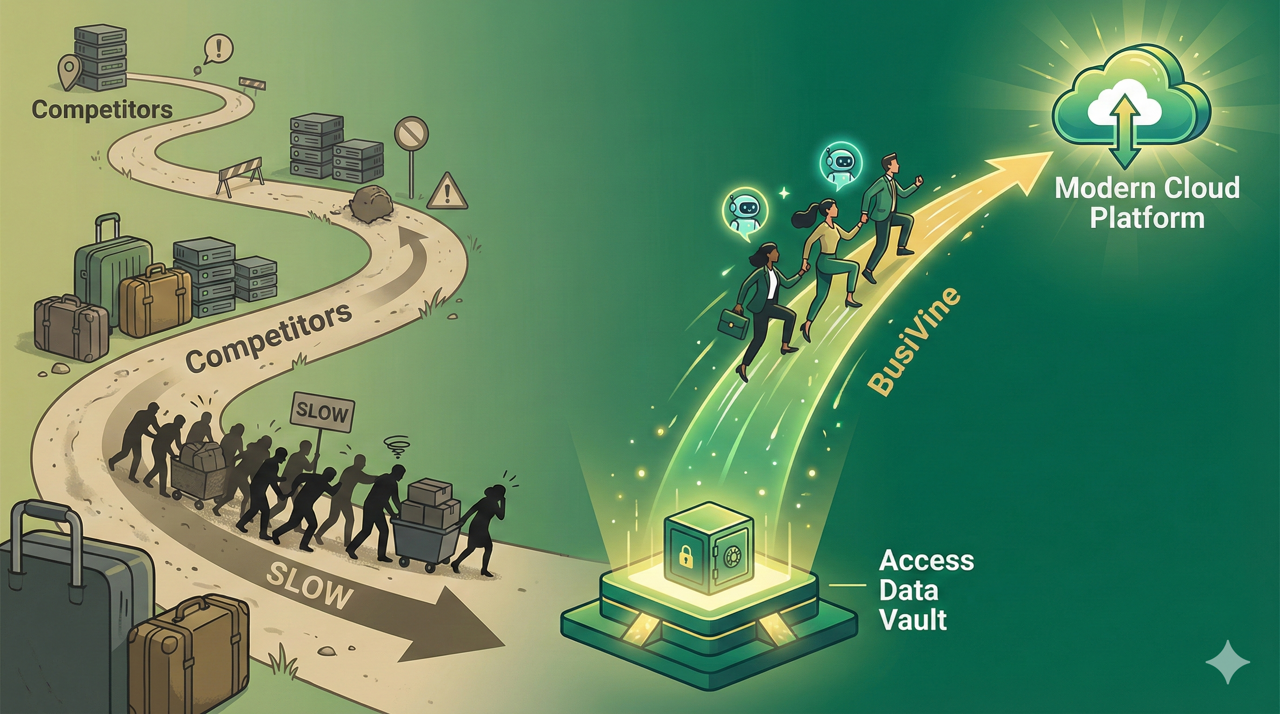
Every established ag-tech SaaS player is carrying pre-LLM investment: legacy codebases, legacy teams, legacy costs.
BusiVine has:
- Real data — 15+ years, 1.2M transactional records. Institutional knowledge, not synthetic. Moat that must be preserved.
- Industry relationships — established distribution network. Software without distribution is a hobby project.
- AI-native from day one — no pre-LLM SaaS legacy. Build on the current frontier, not around the previous one.
- Zero technical debt in the target platform — every competitor maintaining a 2019-vintage codebase is carrying weight BusiVine doesn't have.